Decoupling interrelated parameters for designing high performance thermoelectric materials
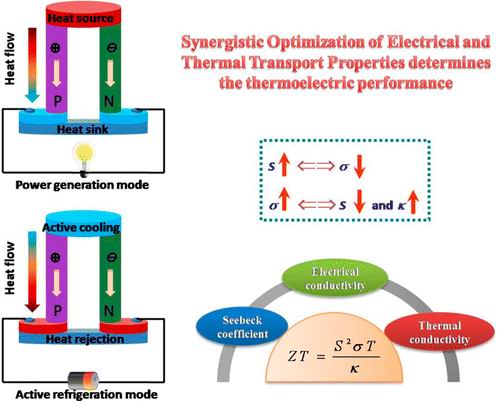
The world’s supply of fossil fuels is quickly being exhausted, and the impact of their overuse is contributing to both climate change and global political unrest. In order to help solve these escalating problems, scientists must find a way to either replace combustion engines or reduce their use. Thermoelectric materials have attracted widespread research interest because of their potential applications as clean and renewable energy sources. They are reliable, lightweight, robust, and environmentally friendly and can reversibly convert between heat and electricity. However, after decades of development, the energy conversion efficiency of thermoelectric devices has been hovering around 10%. This is far below the theoretical predictions, mainly due to the interdependence and coupling between electrical and thermal parameters, which are strongly interrelated through the electronic structure of the materials. Therefore, any strategy that balances or decouples these parameters, in addition to optimizing the materials intrinsic electronic structure, should be critical to the development of thermoelectric technology. In this account, Prof. Yi Xie’s group report their recently developed new strategies to decouple the thermoelectric parameters for synergistic optimization of thermoelectric performance, including utilizing phase transition and superionic conductors with disordered structure to decouple the power factor and thermal conductivity. Most exciting, both the creation of spin entropy in wide-gap semiconductors and the fabrication of an ultrathinnanosheet-based composite with 2D electron gas preliminarily realized the decoupling optimization of three parameters. From their own and other research groups’ results, they envision that the proper choice of nanostructured materials with intrinsic characteristics, in their bulk counterpart, such as phase transition and so on, could be a general route to decouple the strongly interrelated parameters for significantly enhanced thermoelectric performance. All of these approaches are decided from materials synthesis and characterization to understand the underlying physical and chemical mechanisms, which require collaborations between chemists, physicists, and materials scientists.
On the basis of these original works, Prof. Xie’s group was invited to publish an overview article with topic of “Decoupling Interrelated Parameters for Designing High Performance Thermoelectric Materials” on Acc. Chem. Res. The article systematically summarizes new strategies to decouple the thermoelectric parameters for synergistic optimization of thermoelectric performance and indicates that the global need for sustainable energy coupled with the recent advances in thermoelectrics inspires a growing excitement in this field, but there is still much work to be done in this area before materials with the high thermoelectric figure-of-merit necessary for wide applications are found or created. They are hopeful and optimistic that progress continued at the pace of the past 10 years will lead to additional large leaps in the thermoelectric figure of merit. (Chong Xiao, Zhou Li, Kun Li, Pengcheng Huang, and Yi Xie,Acc. Chem. Res. 2014, doi 10.1021/ar400290f).
Resources from: http://pubs.acs.org/doi/pdf/10.1021/ar400290f